Industry Trends
Marketing Insights

Written By
Wray Ward
Design & Construction Week is the premier annual event for the homebuilding and remodeling industry, bringing together the latest product innovations, design trends and industry thought leaders under one roof.
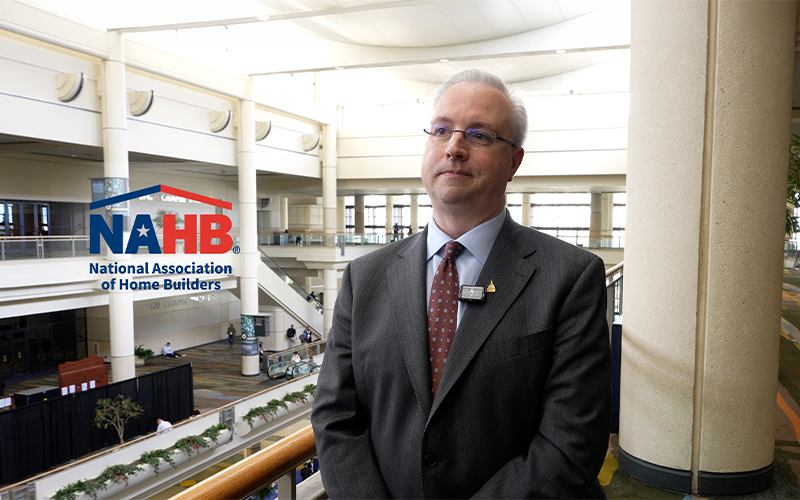
This year, the Wray Ward team spent time on the trade show floor connecting with some of the leading experts shaping the market, including Zonda, a research and advisory firm that delivers data-driven insights for the entire homebuilding life cycle. We had the opportunity to talk with Todd Tomalak, head of building products research and advisory, and Jacob Belk, vice president of building products advisory, to discuss emerging trends, industry challenges and actionable insights for marketers in the home and building space. Their perspectives shed light on what’s influencing homeowner and professional decision-making and how brands can respond strategically.
Here’s a closer look at our conversation with Todd and Jacob.
What’s an uncomfortable truth about the building industry that leaders need to acknowledge right now?
Todd Tomalak: When the market turns, it will turn much faster and be in a different distribution than I think most manufacturers are prepared for or have in mind. So that’s going to mean big changes in market share, big changes in pricing power — maybe a bit like what happened in 2021 but from a different angle.
Jacob Belk: I would add that a lot of leaders in the building products industry tend to get caught up in a single narrative around the industry rather than considering those big changes and variants that are going to happen between categories. They tend to think about it as a whole industry rather than between different categories. And you can have some categories that go great and some that are weaker.
If you had to place a bet on the one shift that will define the next year or two in housing, what would it be and why?
Todd Tomalak: I think this is the year that we see home equity extraction begin to trickle into home improvement and remodeling. Where it shows up first is in luxury appliances. We’re seeing a little bit of that at the show. So this is the turning point, but we think slow growth this year, a little bit more rapid growth next year.
What have you learned about why remodeling has been slow to rebound, and how should brands use this insight?
Jacob Belk: When you think about it, every year you come to the builder show and there’s all sorts of these new innovations around products, and many of those talk about durability, how long the product is going to last. That’s been happening for a long time. That has to have an impact on how long the remodel cycle is, right? When there are all of these great innovations happening — materials and methods are getting better and better — that’s going to impact how long those materials last and whether that remodel can be deferred or whether it’s something that needs to happen immediately.
Todd Tomalak: People used to put wood decks in and now they put composite decks in. They used to put in carpet. Now they have floors that last much longer. The consequence of that stretch is it gets more volatile when the market begins to turn, and it all clusters together. So instead of doing just a flooring job, they do flooring and a window job and a kitchen job all at the same time. Different contractor, different channel. We’ve modeled that out at length. There are a lot of implications, but that’s new to us. I think it’s the first time we’re really seeing it in the data in concrete terms.
One more thing we need to think through as an industry is that for many products that were installed in the construction boom prior to the great financial crisis, we are already through that initial remodel cycle. We’re now entering the period where the homes coming up for repair and remodel are those built after the great financial crisis. And as we know, there weren’t very many homes built from 2008 to 2012. Those were really tough construction years, and so that’s the base volume you’re working from that’s coming up for refreshes as systems degrade and need to be replaced.
With growing pro influence, how can brands balance consumer-facing marketing with a contractor-driven decision-making process?
Jacob Belk: Something really interesting that I’ve noticed this year at IBS is that some brands are shifting their messaging a little bit more toward the pro. They’re marketing more toward, “This is the reason that you should choose our brand — we’re made for you, the installer.”
I think there probably needs to be a little bit of a shift from consumer toward pro marketing because as remodel projects become more complex, you’re going to need a pro to handle a wide variety of different projects. And that’s going to give that pro some pro veto power.
However, we’ve also heard from companies that have partnered with influencers, and those products have been huge sellers, huge successes. So it’s a bit of a pincer movement — you probably need to speak to the pro, but then find the right ambassador to speak to the consumer rather than you speaking directly. That seems to be a really fruitful path.
With labor shortages reshaping expectations, how should brands message labor-saving features?
Todd Tomalak: I have a little bit of a contrarian view on that. For a long time, we saw the focus be on reliability and dependability — all of those things matter because pros don’t want callbacks. But with where we’re going with the labor force, we’re going to have fewer workers, fewer installers, and it’s hard to infill them with the same quality labor.
What we think is interesting messaging is brands that can deliver a product that reduces the skill level required to install it reliably. If you’re leading a pro crew, you might be comfortable bidding on a job even if you didn’t have a direct line to a master plumber.
Jacob Belk: It’s a shift from messaging that it takes a pro half the time to install to messaging more toward you don’t have to be a pro plumber at all in order to do this. There’s a difference in the type of labor savings that will become applicable in the future.
How can brands better leverage research and data to align messaging with what pros and buyers actually want?
Todd Tomalak: A lot of manufacturers compare themselves versus their competitor peer group. What we think is more practical is to look at the general basket. If they’re pitching a faucet at a higher price point, we want to know what else is attached to that. Do they change cabinets or floors? When that faucet goes in, what’s the general value it’s bringing?
We’ve been looking at data that tracks upgrade rates when people are configuring their homes and disentangling pricing versus all the other products that get adopted. Pros want to sell more. If they can sell five more products, we can identify what those are.
Jacob Belk: It’s important to remember that the data and information space today is radically different than even three years ago. Between AI and increased compute capabilities, there’s a totally different set of data available. The world is increasingly moving from survey-driven insights to direct measurement of what consumers are actually purchasing. You’re not relying on memory — you have access to actual purchasing data.
Todd Tomalak: The census and the BLS (Bureau of Labor Statistics) are struggling to get survey responses. And if they are struggling, so are all the other research firms that are in the survey business. So the way to look at that is you have to collect multiple data points observationally as people are making real decisions.
What are the biggest barriers preventing crews from adopting new solutions, and how can marketing overcome them?
Jacob Belk: There’s a bit of a first-mover disadvantage. If you’re the first guy to show up on the jobsite or the first to spec something new, there is a disadvantage — whether it’s how you’re viewed by peers or distrust based on new technology that hasn’t worked out before.
Brands can help overcome that by providing additional support and context. You’ve got to help the first people get that ball rolling downhill, and then it becomes more widely accepted. Also focus on connecting the dots between the new product or technology and the outcome — making sure those results are widely known, whether it’s that it saves time, money or headaches.
Todd Tomalak: I’m a big fan of manufacturers that physically take solutions on-site to pros — like a trailer they tow to a jobsite or design center and give them a tour. They see it, they touch it, the fear goes away, and then they can communicate it to customers in a way that’s easy to remember. We’ve seen some really large adoption changes happen that way.
Jacob Belk: It seems like adoption happens very slowly and then all at once. Some of what a marketing team can do is provide the background and context so that when that “all at once” moment comes, people are familiar with what it is and then you see a rapid increase in adoption.